Saturday, March 22, 2014

" a place to stay "

sunday, march 23,  2 a.m.


Being on the eve of going rusticating down in the south west of france for  a few days, looking for new adventures, the Reporter yesterday decided to have a look at possible Parisian places where she might stay on her next trip to france,  the land of the Polite.

As a matter of fact,  the Reporter has some pretty nice idea of the type of place she would like to own in, or around Paris.

Do not shiver, Reader,  some of the suburbia around Paris is in fact quite charming, and any Parisian would tell you,  "  La, il y a du bon air. "   which really simply means "  There, there is some nicer fresh air", since so much of the press lately has blatantly lied about Paris air quality talking about thin particles and unhealthy haze.  " Balderdash" would tell you any Parisian, except they don't speak that good of an english, so they will just say something like " foutaise"  which is a word you should never use, and means something like " crap " but since it is in french it is more elegant, still you should really not use that  foutaise.

So the Reporter did have something in mind like that,

a small simple house,  surrounded by a little greenery,
so she showed that to the Broker, but then looking more closely,

the Reporter noticed that there was a lot of dogs, and the inside yard of the cute house had in fact a well to pull up pails of water, and  < gasp >   dirt ground and no gravel.

So she took back her photo and threw it away,  and said to the Broker that it was a little  too much rustication for her.  Except that it was not really a photo but a seventeenth century small but rigid painting,  and try to throw that away in one of the "poubelles" [ garbage can ] of a Parisian street.

So she explained that all she wanted was just some sort of well kept back yard, like this


with some tall trees,  may be a pond  like that one,
or like this one,


a bit of columns like that, for her daily walking meditation


and a bit of french windows and a tree turning orange in the Fall
and the Broker was horrified and exclaimed " Mais c'est Versailles et ca n'est pas a vendre du tout !"
 which roughly, simply, means " But it is Versailles and it is not for sale at all."

Which the Reporter thought was a pretty rude answer, for once, coming from the french.

And also, did you notice how much the french start a sentence with " But it is..." but I digress.

Of course the Reporter didn't want to buy Versailles, which is a very windy place with fireplaces not all of them working, she just wanted a small something like that.

Then, the Reporter who shows always great equanimity in all situations invited the Broker to have a little salad of  "  lamelles tièdes de pommes de terre a l'huile de truffes et au sel de Guerande"  which only means " slices of warm potatoes with bits of truffle oil and coarse grey salt ".  And the Broker's high ventilating mood evaporated.
Then it was a return to the little favorite public garden, "  Le Jardin de Catherine Labouree "  which is right next to the nuns convents who eat religiously their " religieuses,"  


 and where you can find a small painted poster which says : "  Pelouse au repos hivernal du 15/10 au 15/04"

 That roughly means " Lawn in winter rest from the 15/10 to the 15/04"   and I know what you feel, dear Reader,  they switched dates and  got them all wrong, it should be 15/04 to 15/10,  except we do not have a 15th month, and one more time,  this is the exquisite complexity of the french who put the  day before the month.

So it does mean from the 15th of September to the 15th of April.  There is  something comforting that the winter rest for the  pelouses in france is between those dates. Winter rest is of primary importance in france. The french don't mind a little winter rest themselves from all their occupations and affairs.

Then the Reporter slipped into a dress to try to look elegant,  and she went to one of these decadent " soirees "  [ evening parties ]  that the french love. That one was overlooking  Place de la Concorde
[ The Concorde Plaza ]  and had lots of soft lights and moldings,


with people who are very polite and squeeze you a bit when you get to the "  buffet"  which is roughly and simply a "buffet dinner"  and where you can observe how delicately and elegantly the french can drink large quantities of champagne while talking enthusiastically of how the stock has dropped two points.


Then they repast to the balcony under  "  la  colonnade "   [ the colonnade ]  to talk about private life, philosophy and ski shoes.


Then they look at the view :


Then because sometimes people with the Reporter are still hungry, because they forgot to get close to  le buffet, and they know that even at midnight they can get some more food to maintain their weight, the french go to Lipp, the brasserie,


and then it is about 2 am and they go to bed.


With all Love,

the Frog


" what the french do when they sit down "

saturday, march 22


Ever courageous, hard-working and intellectually brilliant, the Reporter went to have a work breakfast with a friend yesterday morning.

So their meeting was, how surprising, at La Grande Epicerie,  where they would order " un café"
which of course is a coffee, a freshly squeezed orange juice,   " une orange pressée " [ move over tropicana ]


and


a croissant


and then they sat down and worked very hard.


This gave the Reporter a new vision on the way the french sit down and work.

When the french sit down for work at breakfast,  in a public place, unlike their american counterpart, they do not just get in, and sit and plunge into the menu and start conversation.

The french sit,  never look at the menu,  but first evaluate the guests around them.  Do they know anyone sitting there yet ?  Do the guests have some social affinity with them ?  If they are sitting with you, they will bend their head towards you, still looking around and say in a low voice  either , "  Le public est bien"  which  roughly means,  " audience is fine, we can sit here "   or it's a negative and they whisper even lower,
"  pas très relevée l'assistance "   which means literally "  not very refined the audience."

Considering this is coming from the french who find most people not quite up to their own standing, the negative comment prevails.  Then they look at the menu.

Then they order,  then you start to talk and work hard. Then they stand up in the middle of a sentence because Guillaume has just come in and they exchange loudly things like " Guillaume,  I didn't  think you were  here [ meaning ' in town ' ] what's up ?"  then they make Guillaume known to you,  then they will whisper about the audience, and check if they don't see anyone that the other knows  sitting there.

Then you can sit back down, all is well, Guillaume has added himself to your small table where you meant to both work, and  everyone sits  until the next person they know will come into the cafe, and join the table.  This is roughly how the french work at a business breakfast. The table becomes too small, everyone ogles the neighbor's table checking if they will leave soon, and the neighbors shoots them back a really mean look.

Cafe territory is very complex in france. In America,  you will smile a friendly smile, engage the conversation with the neighbor, apologize and ask when by chance they might leave, if you want to expand, but no pressure, everyone is happy, it's all very friendly and open.  That is why the french think the americans are very rude.

Which is why, when you walk through the Grande Epicerie, you can check a dish towel which says :


" PLUS D'AMOUR S'IL VOUS PLAIT"

Yes the PL are hidden by the tag, [ photographer had too much coffee ] but that's really what is says, which means,

"MORE LOVE PLEASE"

 but that applies to the person who dries the dishes, not to the people sitting in a cafe.

So let us go back to how and why the french sit down, elsewhere than in a cafe. First about cafes,  if you arrive in Paris and expect to just drop in a Starbuck, just be aware there are 3 Starbucks in Paris, and that is all. So it is not like New York or Los Angeles where Strabucks just pop out like buds in Springtime.

Now the french in fact do sit down, and stay sitting and working in public places in Paris, other than in cafes.

The standard place for a Parisian to sit down and do serious work is the public garden bench.

This is the i-pad bench :

These three gentlemen were all on their i pads and all working pretty hard for at least twenty minutes which was the range of time the Reporter was observing this.

No Guillaume or Marcel  came to interrupt them. When french are working on their e pad or i phone, it is very rude to interrupt them.

Most french work on their i phone all the time, which makes you rude anyway any time you would like to have with them a human interaction.

Then you have the bench conversation :


This one takes place near Le Grand Palais, where all those very proper french went to see the last show from Bill Viola,  and they are all deep into conversation about Bill Viola's aims and methods and points of view and private life.

This type of sitting, you do not interrupt either if you do not want to be rude :
First you will notice there's not much place left on the bench,  then you do not interfere into a conversation which is about art and private life. That is a no no.

First you do not know anything about Bill Viola's private life and they do.  Second, your view on Bill Viola's art and methods are most probably not the view of these very proper gentlemen and ladies, and they already do not  quite agree on Bill Viola's methods and aims between  themselves,  so imagine if you came into the conversation like a rude American, about something you completely ignore when they don't.

This by the way is the entrance to Bill Viola's,  just if you are interested.


The Reporter needed to buy a book so to the bookstore,  and there, they were other french sitting down,


and they were two proper persons, unknown to each other sitting down and reading in that book store, and those two also, you do not interrupt because they are reading in a public place which is not a cafe, so you do not interrupt at all,  you rude American.

That is because when a french reads in a book store this is what it means :


Then the courageous Reporter went on her way and she met Suzy,
who is an Australian and lives in London, but she is lovely, and doesn't mind being interrupted rudely by the Reporter,
Suzy is delightful, she has this basket in the shape of a beetle into which she confines her handbag from the sun rays, it's very handy.

Then the Reporter had another meeting in another cafe because the Reporter is very busy, so she sat there at this Trocadero place,


you will notice there is that young Francois standing up on the right side of the pic,  in deep conversation with young ladies who are having a late lunch [  6 pm ] and he is not about  sitting down.

This is the other way a proper french will not sit down in a cafe, as he is just having a quite small exchange, he doesn't have time to sit down, so he is in fact standing there for like about twenty minutes in deeply serious conversation, before straddling his vespa.

A french waiter should get normally aggravated by the fact that he is taking like half the width of the aisle to talk of deeply serious things for twenty minutes,  but in fact that is where the waiter will just shrug and say "  Non, c'est un bavard."  which roughly means " no, it's just a windbag."

And that was like the end of the day for observing the way the french sit down, and are all so polite while the rest of us is so rude.

With all Love,
the Frog


Friday, March 21, 2014

" l'epicerie"

thursday,  march 21


In Paris if you need to buy last minute food, you climb down the stairs and run to your local grocer,  "l'epicerie,"  or  "chez l'epicier,"  that's your local grocer.

 It is often a charming cramped store, usually titled like "  La Ferme Vaneau"  which is not a farm but just a grocer. The fake farm has an incredible assortment of products, produce, wines and waters in the tiniest square feet you can imagine. The grocer may look down on you like you are an intruder, but if you politely say, " Bonjour Monsieur,"  he will become amiable, and if you talk of the soccer game you can hear streaming on the radio in the back store, then he will be, to you, downright adorable. If more than one customer is in, people are very careful to line silently, and not touch each other in aisles that are like 1/5 of an airplane aisle.

If while you are paying, another customer comes intruding, doesn't say " Bonjour Monsieur," and starts moving products on the shelf to check the labels, the grocer will look up at you, while giving you back the change,  with the martyre air of a beaten puppy. You will smile back with the compassion  of someone who understands deep down the depth of humanity issues,  and he will give you a Carambar for free. A Carambar is a soft sort of caramel. Any child in france knows what a Carambar is.

But, if you are not looking for a last minute food at the foot of your apartment, then you treat yourself to "  La Grande Epicerie "  or the Big Grocer.  It is at the foot of the Bon Marche, and for sure the Reporter had reported on it before on this splendid blog. But, today we entered a new phase since, about a few months ago, the  Grande Epicerie ended its full remodeling  to something absolutely grand.

So the Reporter had to visit it on her first days in Paris,

So there, she could ogle at the veggie stands,  a favorite,


another stand of vegetables, so another favorite,


and the tomato stand, a favorite too,


then the fish stand of course, her favorite,  or  " La Poissonnerie "  with its awesome mosaic wall,


and then next, she went on to the sweet delicacies,
so two brands of " copeaux de chocolat"  which simply means chocolate chips really, which you buy to make your hot chocolate at home,  so you have
"  La Maison Bonnat "   a very old  french alps company,  and they get their chocolate from Trinidad, Ceylon, Hacienda Rosario [ Venezuela ], Chuao, Madagascar, so, as you see it is a very respectable house, la Maison Bonnat. So this is the can :

or the second brand, so called "  Dolfin"   pronounced < doll-feng > and honestly this is a Belgian chocolatier so, you will understand, that can is looked at with some circumspection by the french.


So move over, Nesquick.

Then the Reporter stopped at the Raviolis stand, because after a hot chocolate to warm you up, you do need some raviolis to maintain weight,


and then she stopped to check on the " patisseries " the sort of chi chi pastries that the french love to make.
So there was an assortment of eclairs and   "religieuses"  a word that  means " nuns"  and that is the name given to a pastry very much like an eclair,  except its shape is  round with a little round mound on top and some whipped cream. On the pic, the nuns are on the  left side.


lots of whipped cream as you see, not at all in the limited tastes of the Reporter,  but the Parisian will love their "religieuses," and eat them religiously as it should be done.
Then we have the inevitable little "  macarons "
 which you nimbly eat with a cup of tea from the Maison Damman named
 "  le thé Jardin du Luxembourg "  or the tea " Garden of the Luxembourg " which is located just a few blocks away from the Grande Epicerie. When you are a child, after school around 4 pm you go to the Jardin du Luxembourg to play hide and seek, and run for your life from your friends from school.

The Reporter stopped then by the "  Cremerie"  at the  Grande Epicerie, where there is a whole wall dedicated to  creme fraiche,  which is heavy cream.  This just shows how the french need to have a choice for their heavy cream.

Somewhat saturated with this display, the Reporter hopped onto some other department at the Bon Marche where they had some other exquisite delicacies,

Then from these, the Reporter left the Bon Marche, this entreating den of small iniquities to stop and  gaze pensively at her very beloved florist,

Then the Reporter went home, visually brimming with so much beauty galore.  

With all love,

the Frog  


Sunday, March 16, 2014

" where there is a difference between American and French biking "

sunday, march 16th


Well dear Reader,
this is a very important post,  quite like in fact any post on this site, which is going to be a Dickensian view in depth of the mores of french, and american biking.

If you have little interest in the " petite reine,"  or in our plain english "the little queen ," as the french call the Bike,  then you might be advised to skip this important post.

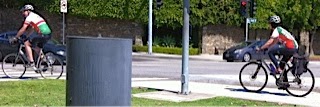
So in United States,  the bikers fall into two categories,  the real normal bikers, like for example these :


and those are the regular normal bikers. That means they have special light helmets,  special tee-shirt made of very complex artificial fabric, with lots of little ads on it,  special biker shoes, special bikers socks, same complex fabric, special wrist-band for the sweat, all this on top of a special light runners bike with special water bottle.

There is a little lance-amstrong-flavorish to the ensemble.

If you look at this regular American biker in his, or her totality, you could say this is a great hommage to the by-products of our oil industry.

And this, dear Reader, is how a regular biker, 1st category,  looks like, at least where the Reporter usually lives. And this seems the high, high majority of the whole lot. We are talking here of about 96%.

Then there is a 2nd  category of bikers, and those,  we have to sadly say, are looked somewhat scornfully on by the first category.

Those bikers are usually using older types of bikes, perhaps a little  more family-looking like, sometimes, < gasp >,  no helmet,  " les cheveux au vent" say the french, which only means " hair in the wind" really, they drive a slightly slower more erratic line, they wear inappropriate jeans, no wrist-band at all, they laugh a lot, chat at the red light and start late,  in one word or rather six,  they seem to enjoy the ride.

When you think deeply about this, it shows that only 4 % of the entire bikers population enjoy the ride, which is kind of sad really.

Now this was for the Americans.

We proceed now to the french mores.

France being a group of very grumpy people, this is where the study is particularly striking.

We would say that we do find the same similar accoutrement [ a french word ] in french bikers as in the hommage to the by-products of the oil industry,  but those are in fact of an infinitely small proportion.

We could say that about 4 % of the french bikers population would have the courage to add to their line of clothing the very special accoutrement of the oil industry.

And we have to say, in the same sad way as before, that the rest of the 96 % looks down on them.

I mean,  if you have french friends who in fact have in their closet the special accoutrement, you may be sure that they will use it in the very early hours of the morning, at dawn, when no one is in sight.

Which in fact makes the figures on the french study somewhat hazy, but then, you know, there is a lot of haziness about the french, unlike our courageous transparency here.

This being said, and I know many of you are thinking ' Well, now, I know everything about the french bikers majority, they wear no helmet, hair in the wind, no wristband, and they enjoy it. Period.'

Well unfortunately, dear Reader, not so fast, for as in everything, the french are much more complex than that.

First, they invented the Bicycle. You should as well know that, immediately.  Never mind that supposedly it was Baron Karl von Drais who first introduced it in Mannheim [ Germany ] in 1817 and then in Paris [ France ]  in 1818,  ask any real parisian,  you will see that wikipedia has it all wrong.

So, because the french invented the Bicycle or " petite reine," well it was normal that the Bon Marche would devote an entire block of its elaborate ground floor to the regular biker.

So, if you visit the Bon Marche in Paris, and are interested in biking the simple french way, first here is the name of that little devoted area :


" en selle Marcel "  means "up the saddle  Marcel "  now Marcel rhymes with "selle,"  but honestly Marcel was like a very common low grade undistinguished sort of name in the 50s.

No one wanted to be named Marcel, but as in every hipster historical period, there is  now a revival of all those vilified names, and now,
in the toniest parts of paris there is a lot of little Marcels being born and baptized.  So, " en selle, Marcel."

Next starts the difficult choices of the standard french biker :

First the Bike,
none of that finicky graphite amstrongish bike here, but this one instead :


pliable, folding on itself, and in the Bugatti blue color.

Nice, simple, effective, low key.  Fits in the narrow french parisian elevator.


IF,  you don't like the idea of folding your bike, then  it comes to :
 that one, or the next,


as you see, pale blue, or black. Nothing else.

Then comes the real essential :  the bag to be attached under the back of the saddle.
Now we will have none of those unnatural crude by-products, but this is the perfectly small sized standard leather baglet that you will treasure all of your short life.

  different shades too.


Then to put in the little baglet, the essential " rustines," those are the natural rubber bandages you will put on the holes in your tire, made by  diverse french pot holes you may find on french roads.

Add to the rustines,  the safety chains next. and their cute padlocks in diverse colors,


then most important comes "la sonnette"  or in plain speaking:  "the ring" :


this one below is similar to the one the Reporter had in the fifties when she was barely born, and was given a byciclette as a standard thing to have to move to another place, " les cheveux au vent" hair in the wind,   and enjoy the ride, when you are a french little one.

In the second pic, you also have today a choice of painted ring,  with like gold fish on them, sort of Chinese flavored, not at all the thing if you ask me.


although you can also choose the more sonorous appendice :
along with the pump to pump up your tires at night.


So, as you see dear Reader,  there are definitely slight differences between what is the accoutrement of the standard bike rider in America,  and the one of the very standard french.

The french just think that biking is principally to be used to go buy croissants, or get to  take a stroll at the farmers market.  Biking is not for exercise. Then the french will pedal back to their home,  and stand in front of  tv, for a minute and a half,  and scream at the monitor because their favorite biker in the Tour de France is placing only 14 at the end of that fourth day of the race.

Then they will shrug, and tell you again that biking is " pour faire des courses," which  in plain english is, " to run errands,"  with all your rustines and sonnettes, but certainly  not for  exercise.
Exercise is for " ces fous" or in plain english, " these nuts" that ride le Tour de France.

Such are the mores in the world of french bikers.

With all love,

the Frog

Saturday, March 15, 2014

" of peregrination, red tape and pigments "

saturday, march 15th


It may appear that the Reporter disappeared for one year, but lo and behold, the Reporter resurfaces like buds do in the Spring.

Not that it was inexcusable to be absent for,  < gasp >, more than a year, but it happened that this highly intelligent and distinguished reporter embraced what is known as < gasp >, regular life, with like,  responsibilities, usually poorly faced and fulfilled, but with equanimity, enthusiasm and joy.

Some of those dreadful responsibilities involved,  in fact, what they call in french, ' en deplacement ' which roughly means,  simply,  going away to different uninteresting places.

So the Reporter was 'en deplacement' like to north California so she took this interesting pic,


and not only that but she also checked this out :


which might be labeled as 'exceptional californian sunset '  
and then she decided to also become a citizen, because after all, when you don't have much to do,
why not do some thrilling paperwork.

So she did in fact become a citizen after much thrilling channeled procedures.

Here she is, a brand new little one :

 And then, she thought, what the heck, now that she was a new citizen, let's celebrate the country,
and she went right out to the countryside where she decided to honor the American hills, and trees, and meadows,

as in here :

And then, after having done this one masterpiece, out of nowhere, she decided to attack a brand new one,
like in here :

but, as you can see :


 that one proved a little bit tougher to chew,

and here is a dire example of a fairly rather desperate artist, 


So, it is on that pretty depressing image that we are going to end the first chapter of this glorious new year of 2014.

Many more adventures are afoot, and in fact starting in the next three or four days, we should have an important message directly from the City of Lights !

With all thoughts,  and usual good wishes to All,

the Frog